About Kedarnath:
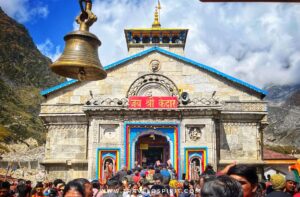
Kedarnath Dham is not only amongst the 12 Jyotirlinga but also is one of the Chota Char Dham. Kedarnath means the “Lord of Fields”. Being amongst the most sacred pilgrimage sites in India, Kedarnath is an ancient temple with its earliest reference dating back to the 7th or 8th Century. However, no one is certain who built the Temple. Kedarnath is situated at an altitude of 3,585 meters in Rudrapryag District of Uttarakhand near Chorabari Glacier, the source of River Mandakini, nestled beautifully in the lap of snow-capped Garhwal Himalayan Ranges at the base of Kedarnath Mountain and Kedarnath Dome.
Since Kedarnath Temple is one the remotest of the Chota Char Dham, to reach Kedarnath Temple you have to do a moderate level trekking of 22km. Each year millions of devotees of all age groups trek to offer prayers and seek Lord Shiva’s blessings. It is said that whoever does this pilgrimage, Lord Shiva fulfils all his wishes.
History, Legend, and Mythology:
There are many legends associated with the origin of Kedarnath Temple. But the most popular one is the Legends of the Pandavas.It is said that the Pandavas after the battle of the Kurukshetra, wanted to seek Lord Shiva’s blessing and compensate for the sin they committed by killing their own in the battle. But Lord Shiva wanted to avoid the meeting and escaped taking the form of a Bull but found himself surrounded by the Pandavas at Kedarnath. However, Lord Shiva then vanished into the ground with only his hump on the surface which is now worshipped at Kedarnath Temple.
Weather Conditions:
As Kedarnath is located at a very high altitude in the Himalayas, it follows the Himalayan weather which is cool summers and chilly and harsh winters. In the monsoon season, the area experiences heavy rainfall and landslides are quite common. In the year 2013, the area experienced severe rainfall which resulted in catastrophic floods.
The average temperature in summer is around 17 degree Celsius (May to June)
The average temperature in monsoon is around 12 degree Celsius (July to September)
The average temperature in winter dips to sub-zero levels and is covered under heavy snow (October/November to April)
During winter the Palki of Kedarnath is taken to its winter abode in Ukhimath from November to April.
Best time to visit:
The doors of Kedarnath Temple usually open in the last week of April or the first week of May.
The best time to visit Kedarnath Temple is from May to June when the weather is pleasant but is quite crowded.
The second best option to visit is from September end to mid-October when the monsoons have receded and the weather starts to get a little colder. Also, it is less crowded during this time.
Although people do go on the pilgrimage during monsoon, it is advised best to avoid it as the rainfall can get severe anytime and may result in landslides or floods.
How to reach:
Flight:
You can take a flight to Jolly Grant Airport (Dehradun) which is well-connected to most of the major airports in India. From Dehradun Airport you can take a direct cab to Gaurikund.
Train:
The nearest railway station is Haridwar/Rishikesh which is around 200km from Gaurikund. There are many public buses, shared cabs, and private cabs which will drop you to Gaurikund.
Road:
The last motorable point to reach Kedarnath is Gaurikund located on NH58 which is well connected by most of the cities in Uttarakhand. From Gaurikund you will have to start your 22km trek to Kedarnath Temple.
Helicopter Services:
Helicopter Shuttles run from helipads at Sirsi, Phata, and Guptkashi. The one-way ticket fare starts from Rs. 2,340 and the return ticket fare from Rs. 4,680 (fare for year 2023). The tickets can be booked from the official authorized website of Uttarakhand i.e. IRCTC.
Where to stay:
There are various stay options available at Kedarnath from Camps to Dormitory and Hotels. The price is high during peak seasons and low during the off-season. GMVN Camps and Cottages are the cheapest options that you can find. The booking for GMVN can be done online through their official website but has to be done well in advance as it gets fully booked fast.
Things to do near Kedarnath Temple:
Kedarnath Temple:
Dedicated to Lord Shiva, Kedarnath is amongst one of the most powerful Shiva Temples in the world and is also one of the Panch Kedar, Char Dham, and Jyotirlinga. Inside the temple, there is a conical-shaped lingam which is worshipped as the Sadashiva. The temple opens at 6 am for Darshan and closes at 7 pm with a break from 3 pm to 5 pm.
Bhairavnath Temple:
Bhairavnath or Bhairav Baba Temple is located on the eastern hill near Kedarnath Temple. You can reach the temple by doing an easy level trek of 1.5-2Km which takes around 30-60 minutes. Bhairavnath is a powerful manifestation or avatar of Lord Shiva and it is also the protector of Kedarnath Temple. It is said that Kedarnath Pilgrimage is not complete until you visit this temple. The temple offers spectacular views of the Himalayas.
Vasuki Tal Trek:
If you love trekking then you can consider going on Vasuki Tal Trek which is an 8km moderate to challenging level trek from Kedarnath Temple. Vasuki Tal is a glacial lake located at an altitude of 4,150 meters. The lake offers stunning views of Mandakini Valley and Chaukhamba Peaks.
Bhimshila Rock:
Bhimshila Rock is a mysterious large boulder right at the backside of Kedarnath Temple. During the flash flood of 2013, when the entire area surrounding Kedarnath Temple was devasted, the rock appeared from nowhere and protected the temple from the gushing waters coming downwards from Chorabari Lake along with land and mudslides at an extremely dangerous speed. The Bhimshila rock deviated from the water flow and saved the temple from devastation.
Tips and Things to keep in mind:
- As per Uttarakhand Govt., every pilgrim needs to do a biometric registration which can be done online and offline at Sonprayag
- Government registered Mules, Horses, Palkis and Porters are available at government-agreed prices. However, remember to check their official IDs before hiring them
- It is advised to avoid the trek during Monsoon keeping in mind the tragedy of 2013
- Photography is not allowed on temple premises
- Start trekking early in the morning as the trek is 22km long and takes any time between 8-12hrs depending upon your fitness level
- Go slow on the trek, take enough breaks, be hydrated, eat healthy foods, and carry a light bag pack.